MySQL on Linux
MySQL - Introduction
MySQL is a relational database management system (RDBMS).
The
Database is a system for store, organize and retrieve large amount of data fast and easily. It have a collection of data for multiple uses in digital form.
A
Database Management System (DBMS) is a set of computer programs that controls the creation, maintenance, and the use of a database. A DBMS is a system software package that helps the use of integrated collection of data records and files known as databases. It allows different user application programs to easily access the same database. In large systems, a DBMS allows users and other software to store and retrieve data in a structured way. Instead of having to write computer programs to extract information, user can ask simple questions in a query language. DBMSs may use any of a variety of database models, such as the network model or relational model.
A
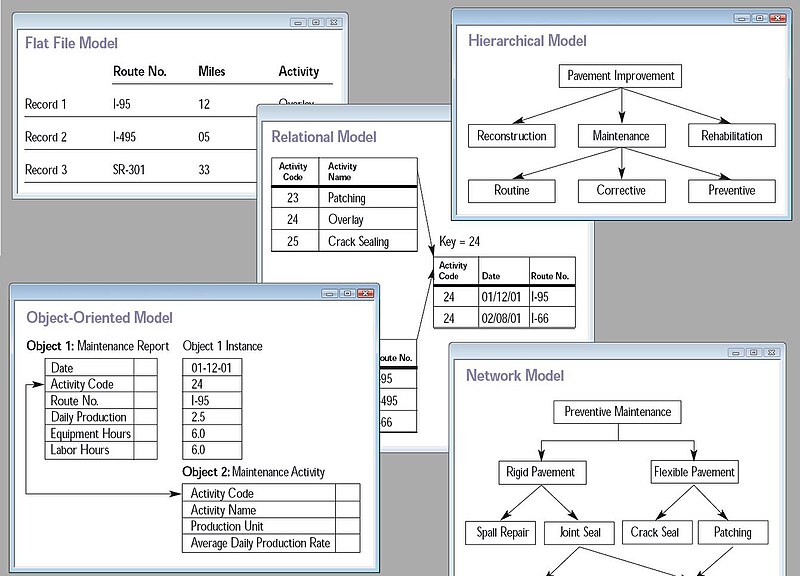
Database model is the theoretical foundation of a database and fundamentally determines in which manner data can be stored, organized and manipulated in a database system. It thereby defines the infrastructure offered by a particular database system. The most popular example of a database model is the relational model.
Models:
- Hierarchical model
- Network model
- Relational model
- Entity-relationship
- Object-relational model
- Object model
The
relational model for database management is a database model based on
first-order predicate logic, first formulated and proposed in 1969 by E.F. Codd.
A
relational database management system (RDBMS) is a database management system (DBMS) that is based on the relational model as introduced by E. F. Codd. Most popular commercial and open source databases currently in use are based on the relational database model.
A short definition of an RDBMS may be a DBMS in which data is stored in the form of tables and the relationship among the data is also stored in the form of tables.
SQL - Structured Query Language is database computer language designed for managing data in Relational database management system. ( Developed by IDM )
MySQL - is a relational database management system (RDBMS
) that runs as a server providing multi-user access to a number of databases. The MySQL development project has made its source code available under the terms of the GNU General Public License, as well as under a variety of proprietary agreements. MySQL was owned and sponsored by a single for-profit firm, the Swedish company MySQL AB, now owned by Oracle Corporation.
Difference between SQL & MySQL
SQL (Structured Query Language) is computer language that can be used to access data stored in relational databases. SQL is not itself a standalone computer application, but is part of many relational Database programs like MySQL, Oracle, Sybase, Microsoft SQL Server, etc.
MySQL is open source database management system. It's an application. It've SQL interpreter, a database manager component, GUI database viewers, and session monitoring tools, etc. MySQL is a multithreaded, multi-user SQL database management system (DBMS) providing multi-user access to a number of databases.
The difference between SQL and MySQL are like, difference between HTML and Dreamweaver. HTML is webpages standard, dreamweaver is computer application that can be used to create, edit webpages.
Reference : Wikipedia and some websites on Internet.